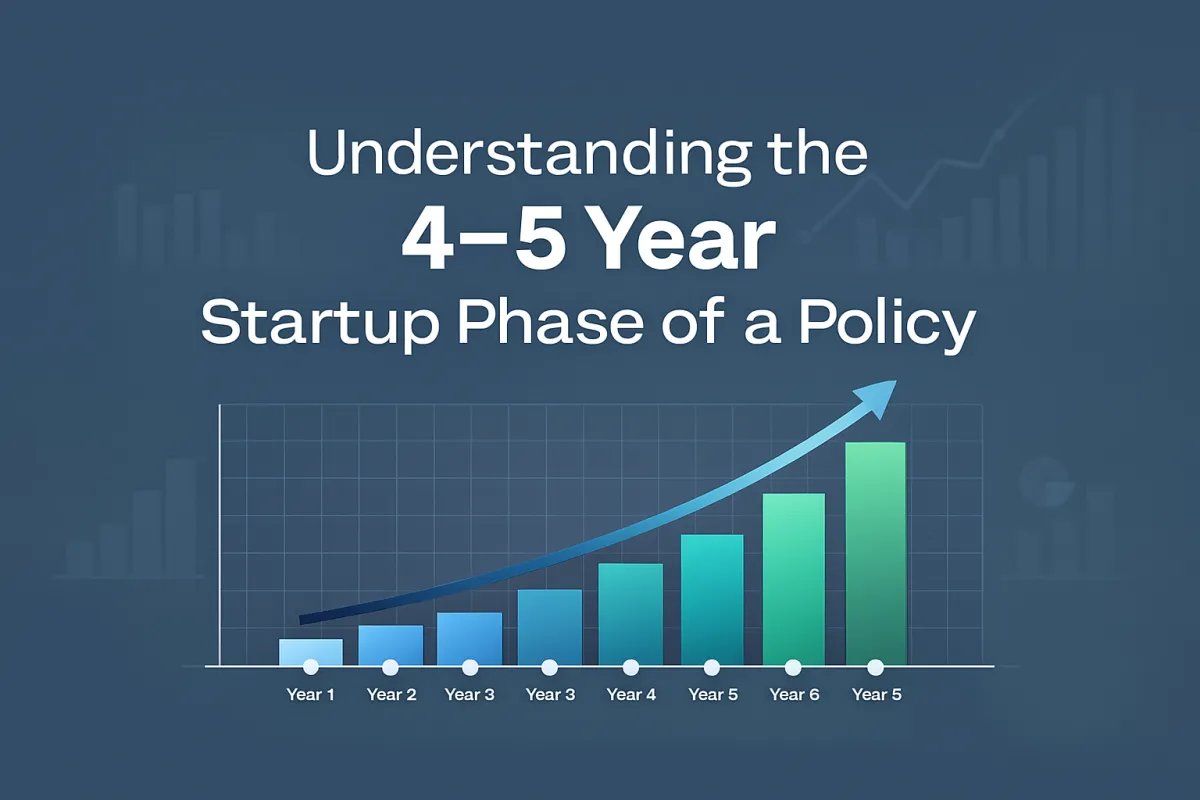
Understanding the 4–5 Year Startup Phase of a Policy
One of the most important lessons for anyone beginning their Infinite Banking journey is understanding why a whole life policy behaves the way it does in the early years. Nelson Nash’s Grocery Store Example helps build this foundation, but the concept becomes even clearer when you compare a policy to starting a business.
Just like any business, a properly structured participating whole life policy goes through a capitalization phase before it becomes efficient and profitable. This early phase often surprises people if they don’t understand what’s happening behind the scenes—so let’s break it down clearly and simply.
A Whole Life Policy Works Like a Startup
In business, the first few years are usually dedicated to building:
• systems
• infrastructure
• cash reserves
• operational momentum
Profit comes later.
Whole life works the same way.
During the first 4–5 years, your policy is building its financial foundation. This shows up as lower cash value access relative to premium paid—but it is not a loss. It is simply the capitalization phase.
Here’s what that typically looks like:
Year 1: Put in $10,000 → immediately access roughly 60% ($6,000)
Year 2: Another $10,000 → access closer to 80%
Year 3–4: Approaching a 1:1 ratio
Year 5: Break-even point
Beyond: Each year becomes more efficient than the last
Even in year one, cash value grows every single day, so that 60% available immediately may end the year closer to 70–75% of the first-year premium.
The point is: the policy becomes more efficient every year it stays in force.
Why the First Few Years Look Like a “Loss”
This is the part most people misunderstand—but once it clicks, the entire Infinite Banking Concept makes sense.
In the early years, the life insurance company is recouping the costs required to set up and administer the policy:
underwriting
medical review
administration
advisor compensation
capital reserve requirements
long-term obligations tied to guarantees
These are front-loaded because the risk to the insurer is lowest at the beginning—so that’s the most logical time for them to recover costs.
This is why whole life policies, especially those designed for IBC, show lower early cash values. It’s not inefficiency. It’s intentional.
Why IBC Policies Look Like a “Money Machine” Later
A high-cash-value IBC policy is designed to optimize growth. Once the early costs are absorbed, the policy’s compounding takes over:
guaranteed cash value increases
dividends purchase paid-up additions
paid-up additions create more death benefit
higher death benefit requires higher cash value
higher cash value generates higher growth next year
It becomes a cycle of self-reinforcing financial efficiency.
This is why policies typically break even around year 4 or 5—and then accelerate dramatically afterward.
From that point forward, every $1 you put into the policy produces more than $1 in new cash value.
The Takeaway
The early years of a whole life policy are not a flaw—they are the foundation.
Just like a new business:
you capitalize first,
build infrastructure second,
and reap the long-term financial benefits after.
Understanding this 4–5 year startup phase is essential. Once you see how a policy grows after the break-even year, you realize why the Infinite Banking Concept emphasizes long-term thinking, discipline, and control.
A slow start is what makes the acceleration possible.

