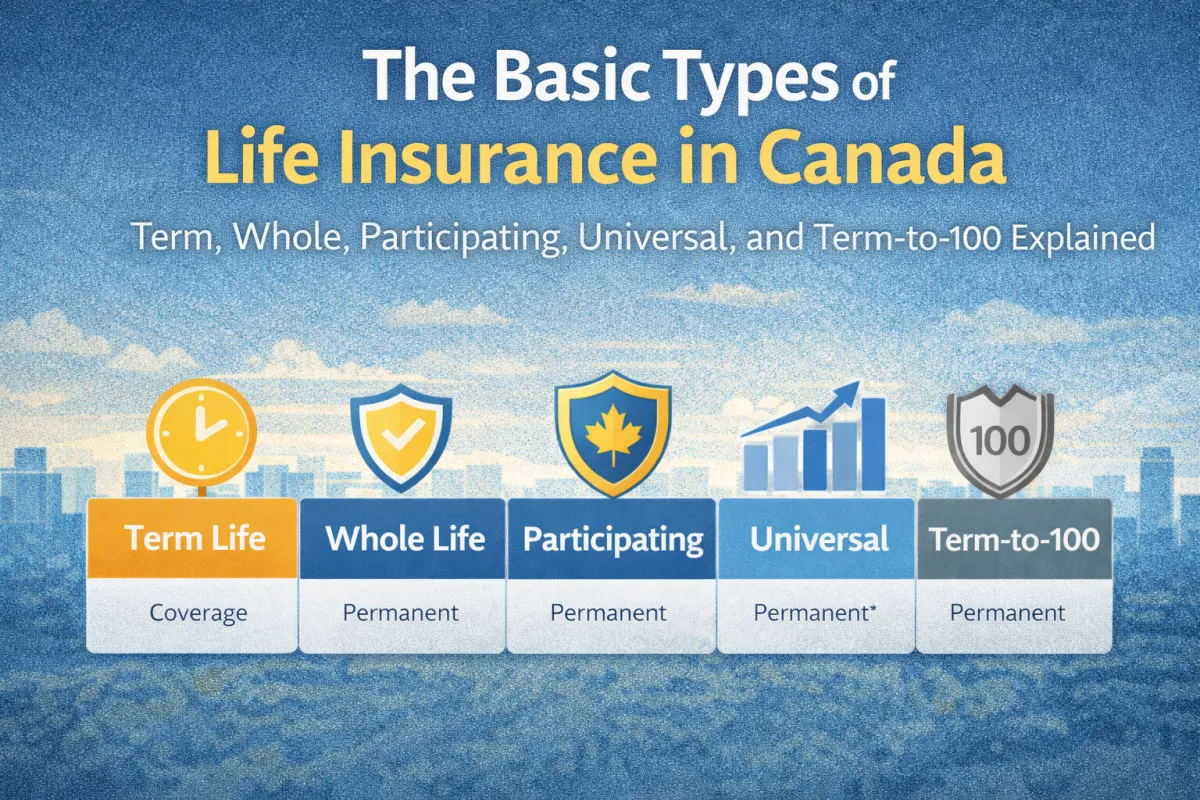
The Basic Types of Life Insurance in Canada (And How to Think About Them)
When most people hear the words life insurance, they think of one thing: a payout when someone dies. While that’s true at a basic level, life insurance in Canada comes in several different forms, each designed to solve a different problem.
The confusion usually starts because policies are often sold by product, not explained by purpose.
This article breaks down the main types of life insurance in Canada, what each one is meant to do, and how to think about them in plain language so you can understand where each type fits and which questions you should be asking.
Why Life Insurance Exists in the First Place
At its core, life insurance is about risk transfer.
If someone depends on your income, your labour, or your presence to keep a household or business running, life insurance is a way to transfer the financial risk of your death to an insurance company.
You pay a premium to transfer the risk. The life carrier then takes that premium, and is responsible for investing and growing that money to cover their liabilities.
Because it is the life carrier that carries the risk, there is a need to qualify for the coverage. This means the life carrier ensures that only healthy individuals are offered insurance coverage. If carriers didn’t do this, they would be taking on too much risk and would be out of business quickly.
From there, different products evolved to solve different versions of that problem:
Temporary risk
Permanent risk
Income replacement
Estate taxes
Long-term planning
Understanding the types helps you understand the toolbox.
1. Term Life Insurance (Temporary Protection)
Term life insurance provides coverage for a specific period of time—commonly 10, 20, or 30 years.
If the insured person passes away during that term, the death benefit is paid. If the term ends and the insured is still alive, the coverage expires. If the coverage expires, you may need to go through underwriting again to see if you qualify for coverage. Certain products are designed to eliminate the need for additional underwriting.
Why term insurance exists
Term insurance is designed to cover temporary financial risks so the burden is not passed on to dependents or family members, such as:
A mortgage
Outstanding loans (student loans, car loans)
Income replacement during working years
Business loans or obligations
Because the probability of death during a short window is relatively low, term insurance is usually the least expensive form of life insurance.
Key characteristics
Low cost
Temporary coverage
No cash value
Premiums increase upon renewal
May become uninsurable later in life
Term insurance is not meant to be permanent. It is a tool to reduce short term risks, not a lifelong solution. Term insurance can be combined with other products to provide additional coverage during high risk periods of life.
2. Whole Life Insurance (Permanent Protection With Guarantees)
Whole life insurance provides coverage for your entire life, as long as premiums are paid. This means the death benefit is guaranteed to pay out, since everyone dies eventually.
Unlike term insurance, whole life policies also build cash value inside the policy over time. Cash value acts like equity building up within the policy. As stated in the contract, the cash value must equal the death benefit at the life insured’s age of 100. This equates to guaranteed daily growth of the cash value.
Why whole life insurance exists
Whole life insurance is designed for permanent needs, such as:
Final expenses
Estate taxes
Wealth transfer
Long-term planning
Long-term financial risks
The cost of insurance is levelled over your lifetime. Instead of getting more expensive as you age, the policy is designed to remain stable. The premiums are higher than term because the cost of the insurance is averaged out over the course of the insured’s life. This means higher premiums in the beginning of the policy, but discounted premium rates as time goes on.
Key characteristics
Lifetime coverage
Level premiums
Guaranteed death benefit
Guaranteed cash value growth
Higher cost than term (but more utility)
Whole life insurance is about certainty. The guarantees are written into the contract.
3. Participating Whole Life Insurance (Ownership + Dividends)
A participating whole life policy is a type of whole life insurance that allows policyholders to share in the insurer’s divisible surplus through dividends. The divisible surplus is generated through the investments of the life carrier on the premiums paid by the participating policy holders.
These dividends are not guaranteed, but in Canada, major life insurers have paid them consistently for generations. This is because life carriers are risk adverse in nature. Meaning they collect more premium than they need to ensure there is a high probability of a surplus.
Why participating policies exist
Participating policies add a layer of flexibility and growth potential on top of the guarantees of whole life insurance.
Dividends can be used to:
Increase the death benefit through paid-up additions
Offset premiums costs
Be taken as cash
When the dividends are reinvested into the policy either through paid-up additions or premium offset, the dividends are tax free. Taking dividends as cash is a taxable event.
Key characteristics
Lifetime coverage
Guarantees + potential dividends
Policyholder participation in insurer profits
Increased long-term flexibility
This is the policy type most often used in advanced planning, because it combines protection, guarantees, and optional growth.
4. Universal Life Insurance (Flexible, But Market-Dependent)
Universal Life (UL) insurance separates the cost of insurance from the investment component.
Part of your premium pays for insurance. The rest is invested in accounts chosen by the policyholder.
Why universal life exists
UL policies were designed for people who want:
Flexible premiums
Investment choice
Tax-sheltered growth inside insurance
The trade-off
The risk shifts to the policyholder. This is very important. Remember that insurance is designed to transfer risk away from the policyholder. Therefore, the insurance carrier is responsible for taking the premium and investing that money to cover their liabilities. UL policies partially shift that responsibility back to the policy holder.
The carrier is still responsible for the liability of the death benefit, and this is offset by the premium price for the insurance increasing every year. The cost of the premium is equivalent to a 1-year term contract.
As the life insured ages, the cost of insurance rises with the probability of death, often drastically near the end of life. Without the protection of level premiums, the longer you live, the more the investment side is drawn down to pay for the expensive premiums. The policyholder is responsible for ensuring the investment account has grown to the point where it can sustain the cost of premiums. This is the added risk.
As you age:
The cost of insurance increases
Investment performance matters more
Poor returns can drain the policy
Policies can collapse later in life if underfunded
Key characteristics
Flexible premiums
Investment risk borne by the owner
Rising insurance costs over time
Less certainty than whole life
Universal life can work in specific situations, but it requires active management and a strong understanding of long-term risk.
5. Term-to-100 (Permanent Coverage Without Cash Value)
Term-to-100 (T100) insurance provides permanent coverage with level premiums, but no cash value.
The policy stays in force as long as premiums are paid, typically until age 100.
Why T100 exists
T100 is designed for people who want:
Permanent insurance
Lower cost than whole life
Estate or tax coverage only
Key characteristics
Lifetime coverage
Level premiums
No cash value
No living benefits
This is a pure insurance solution, not a financial asset.
How to Think About These Policies Strategically
Instead of asking:
“Which life insurance is best?”
A better question is:
“What problem am I trying to solve—and for how long?”
Temporary risk → Term insurance
Permanent obligations → Whole life or T100
Estate and tax planning → Permanent insurance
Flexibility and long-term strategy → Participating whole life
Life insurance works best when it is designed intentionally, not purchased based on price alone. It is also important to know that you can combine different types of insurance. This is where design comes in. Risks evolve as we progress in life.
For example, we can add a term rider to whole life insurance to provide additional coverage during high-risk years such as when you have a mortgage and a young family. The cost of that term insurance is cheap, and the whole life component can be kept at a minimum to keep costs down.
There are many more levers to pull to create the perfect insurance plan, but those require the right conversation with the right advisor.
Final Thoughts
Life insurance in Canada isn’t one-size-fits-all. Each type exists for a reason, and each has strengths and limitations.
When used properly, life insurance is not just a safety net. It becomes a foundational planning tool that supports protection, certainty, and long-term flexibility.
Education always comes first. Strategy comes second. The right design depends on where you are today, and where you want to go next.

