
Strategic Life Insurance for Canadian Armed Forces Members: What I Wish I Knew Before Deployment
Strategic Life Insurance for Military Members – Things I Wish I Knew
Like most Canadian Armed Forces (CAF) members, I will never forget my first deployment. Unlike most CAF members however, my first deployment was to a literal paradise in The Solomon Islands. Such are the luxuries of specializing and being in the right place at the right time. I was 26 years old, married, and we had just had our first child. I remember going through the administrative process before leaving, and it led me to a Life Insurance Agent who was very convincing in letting me know that I was leaving my family unprotected if I deployed without additional insurance. I ended up getting a 20 year term insurance on myself. While providing protection for my family should the worst happen on my deployment, I missed out on an incredible financial opportunity. Let me explain.
When I bought the term insurance, I ended up getting $600,000 of coverage, for the next 20 years, for $39 / month or $468 / year. Over the course of the 20 years, that will end up costing $9,360. Not bad considering if the worst should happen, my family does not have to worry about any of the debts we have (mortgage, cars, etc.). What I wish I knew, was the power of dividend paying Participating Whole Life Insurance. Participating Whole Life Insurance is a product that has been around in Canada for the entirety of its history. It provides coverage for the remainder of the policyholder’s life and is guaranteed to pay out to the beneficiary, unlike term insurance. Participating Whole Life Insurance provides many benefits:
·Guaranteed, tax advantaged daily growth of the policy equity
·Dividends on your equity
·Access to liquid capital through policy loans
·Protection for your family
So how does it work, and why is it important for military families to know this? Participating Whole Life Insurance works in the same sense as term insurance. You buy a certain amount of death benefit and pay for that death benefit with premium. The difference is that Participating Whole Life Insurance has something called Cash Value. Cash Value is the current value of the future death benefit, or it is a side fund where a portion of each premium payment is set aside as equity that accumulates over time until it equals the death benefit of the policy. In the insurance contract, the cash value must equal the death benefit at the life insured’s age of 100. This is very important to remember when we get into discussing the strategic part of how we set up the life insurance policy. On top of this, every year your policy is eligible to receive a dividend from the insurance carrier. I should also note that life insurance carriers that offer Participating Whole Life Policies have never failed to declare a dividend since their inception.
As you build cash value within your policy, you are able to borrow against your policy, using the life carrier’s money, where the collateral for the loan is your death benefit. This means that your cash value continues to grow daily and compound, uninterrupted, because you are not taking your money out of your policy, you are borrowing against it. This is an extremely secure loan for the life carrier because they know at some point in time you will pass away, and they will get their money back even if you still have a loan balance outstanding. This also means that you are in complete control of the repayment schedule. You can repay the loan immediately, in 1 year, in 10 years, or not at all. As long as you understand that the loan is accruing interest annually. At the time of writing this, Equitable Life’s interest rate is 6.5%.
What I should also note is this. The daily growth of the policy will always outpace the accruing of interest, if it is designed properly. I can’t tell you how good it feels to have a access to a large pool of capital, while your money continues to grow and compound uninterrupted. You should of course repay the loan because like a line of credit, every dollar that you pay back into that loan is immediately available to be taken out again. For example, if you took a loan out for $10,000, and you have already repaid $5,000 of it, and you have an unexpected expense of $5,000, you can take that $5,000 right out again to cover that expense.
Why is this important for military families to know? If you design the policy in a specific way, you can create a scenario where your death benefit continually increases. Which means your cash value must also continually increase because contractually, it must equal the death benefit at age 100. This creates an environment where you have purchased protection for your family, but have also inadvertently created a financial tool that grows and compounds uninterrupted, while giving you access to the cash value, through policy loans, on your terms. With the proper coaching, you will see that you have created the ability to control the function of banking in your life. You can finance your own cars, vacations, house down payments and much more all through your life insurance policy. This is called the Infinite Banking Concept. A financial strategy that controls the financial environment, giving you complete control over your money. Suddenly, the simple act of paying for life insurance creates the financial flexibility to finance new vehicles, finance a down payment on a home, cover living expenses for a few months while your spouse looks for another job after a posting. It puts you in complete and total control of your money, all while protecting your family.
I would be remiss if I didn’t talk about the cost. Yes, whole life insurance is more expensive than term insurance. And the cost can seem overwhelming if you think of it as a brand new expense in your budget. The best way to thing about funding this is to imagine that you are placing your money in a place where it provides utility. Instead of dividing up your current income into several different pots; savings, retirement planning, vacation fund ect. We lump them all together in a place where you have complete control over the function of that money. It becomes the pot to hold the money for savings and retirement planning and your vacation fund.
As a planning figure, a Participating Whole Life Policy designed this way, with an original death benefit of $110,000 will cost $1,912 / year or roughly $160 / month, with the option to put up to $4,800 / year or roughly $400 / month. Each dollar over and about the base premium of $1,912 purchases more death benefit, therefore, increasing the growth within your policy. Now this is just an example, we can add other riders to this policy, such as a term insurance rider, that will significantly increase the short term coverage of the policy without adding much cost.
That may seem like a lot, but if you are currently able to save $400 a month across all of your different pots, all you need to do is reallocate that money and funnel it through your policy first before you use it and you have given yourself coverage for your family. If we continue to max out our contributions, something interesting happens around year 5 or 6 of the policy. The efficiency of the growth has reached a point where for each dollar you put into your policy, you have access to more than one dollar in loans. This phenomenon continues throughout the life of the policy where it only gets more efficient over time. For example, below is a breakdown of the premiums for the first 6 years of our example policy in relation to the available cash value.
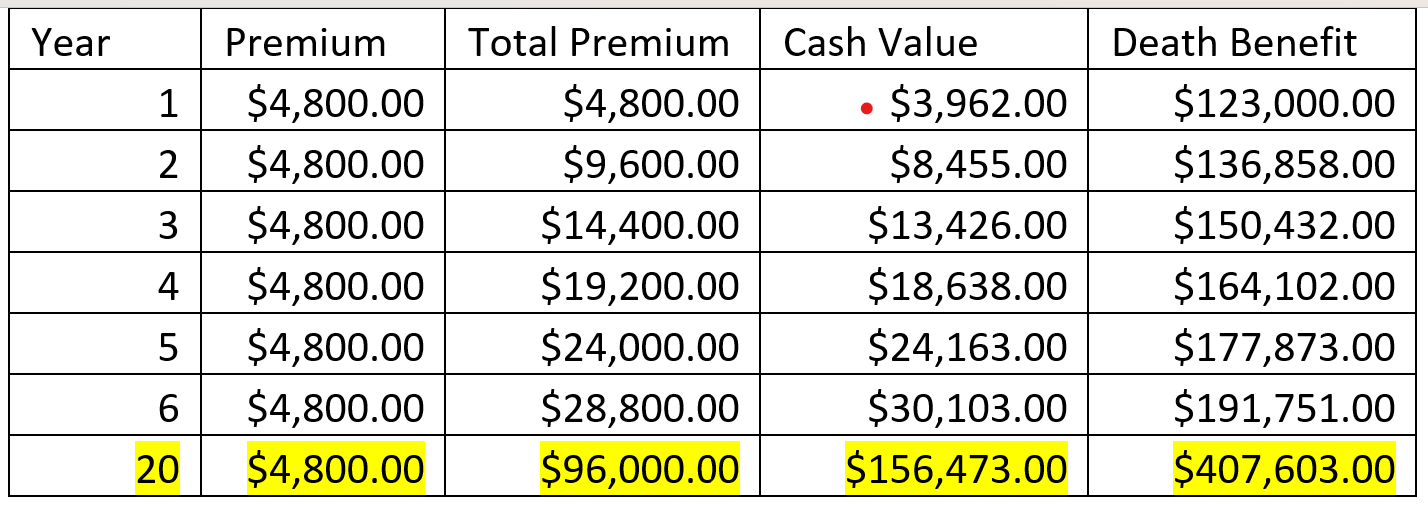
You can see that you break even in year 5, meaning the amount of money you have put into the policy is roughly equal to the amount of money you can access through policy loans. I’ve included year 6 to show that the ratio continues to improve, and will continue to improve throughout the life of the policy. That cash value continues to grow and compound uninterrupted regardless if there is a policy loan or not. It grows as if there is no loan at all, thus increasing your purchasing power every single year. If we remember in the beginning of the article, I told you about my $600,000 20 year term insurance with the total cost of $9,360 over the length of the term. That $9,360 over 20 years bought piece of mind and included a safety net should I pass away while the policy is in place, but that money is gone forever. If instead, I followed the above example, I would have paid significantly more at $96,000, but I have access to $156,473, and I have a death benefit of $407,603.
Remember that the money we used to fund the premium was not an additional expense within our budget. We took items that already existed in our budget, our savings and retirement planning, and changed where we stored that capital. In exchange, we grew our money in a tax advantaged environment, created a pool of capital we have access to with complete control to finance the things we need in life, while simultaneously providing protection for our family. The goal is to synchronize your cash flow and put it in an environment where it works for you and your family, rather than lining the pockets of everyone else.

