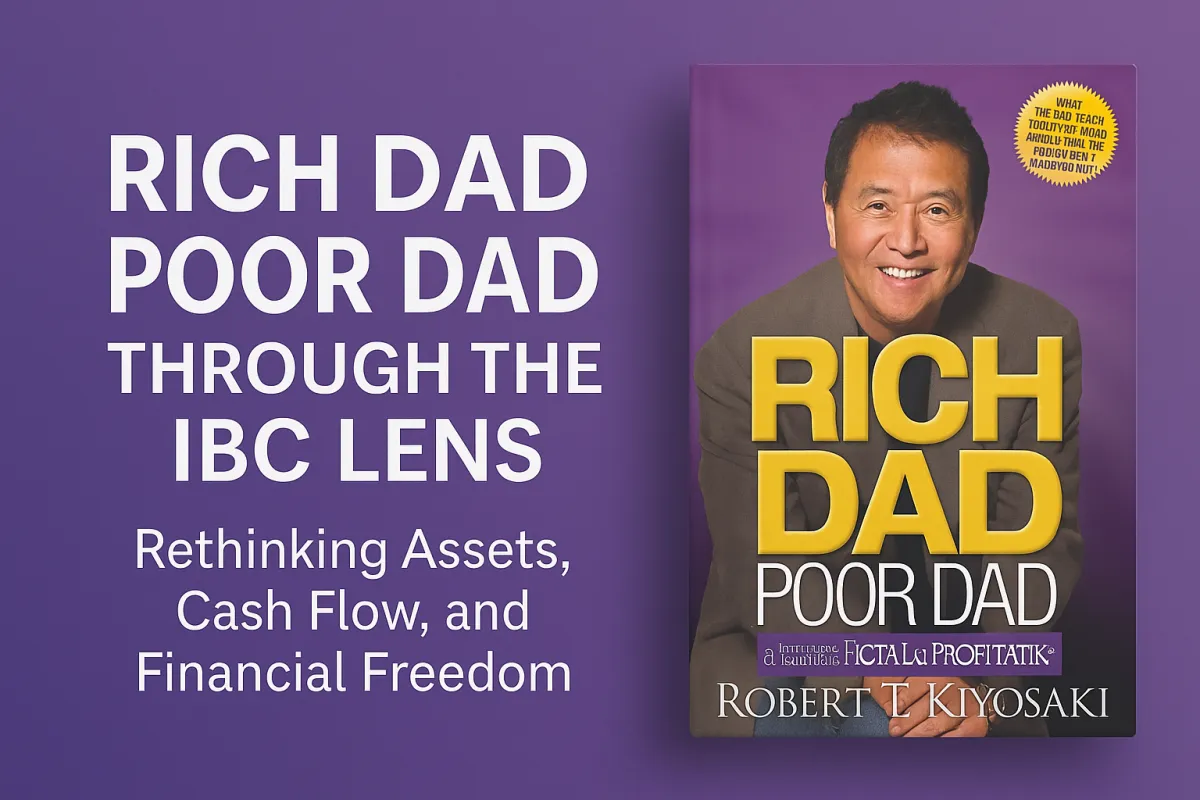
Rich Dad Poor Dad Through the IBC Lens: Rethinking Assets, Cash Flow, and Financial Freedom
One of the best personal finance books ever written, in my opinion, is Rich Dad Poor Dad by Robert Kiyosaki. It’s a fantastic book because it challenges societal norms about money and wealth generation. Robert goes into detail to explain his reasoning on why you should not work for money and instead work for assets.
"Rich Dad Poor Dad" contrasts two mindsets about money; one focused on job security and traditional success (“poor dad”) and one focused on financial independence through assets and investing (“rich dad”). The book uses stories from Robert Kiyosaki’s childhood to show how different beliefs about money lead to very different financial outcomes.
Synopsis of the book
Kiyosaki grows up with two father figures: his highly educated biological father (poor dad), who values formal education, a stable job, and living within one’s means, and his friend’s entrepreneurial father (rich dad), who emphasizes financial education, investing, and owning businesses. Through conversations, small jobs, and lessons from rich dad, Kiyosaki learns how the rich think about money differently: they focus on buying assets that generate income, understanding taxes and corporations, and using money as a tool rather than something to be earned and spent in a cycle he calls the “rat race”.
The book is organized around key lessons—such as “the rich don’t work for money” and “why teach financial literacy”—that show how to escape the pattern of working harder just to pay bills and instead build streams of passive income over time. It closes by urging readers to invest in their financial education, take calculated risks, and use their minds and money to create freedom rather than lifelong dependence on a paycheck.
Core principles and how they show up
Acquire assets, not liabilities
Assets are things that put money in your pocket (businesses, rentals, investments), while liabilities take money out (consumer debt, houses or cars that only cost you). The rich prioritize building an asset column that generates cash flow.
What people fail to realize is that the function of banking can simultaneously be used to build a cash generating asset. When you build a banking system, you are simultaneously starting a business. That business is a banking business that works for you. It will continue to generate revenue each and every day in the form of cash value. You can then leverage this money to fund new opportunities to acquire more assets.
Make money work for you
Rather than trading time for money forever, use income to buy or build assets so that cash flow from investments eventually covers living expenses and creates freedom of time and choice.
There is no better fundamental strategy to accomplish this then getting into the banking business. Businesses come and go, but banking is eternal. It is quite literally the backbone of most economies. If you can tap into that function, you not only create a system you control to finance the things you need in life, but you also are building a cash generating asset that is well suited to provide tax-advantaged passive income later in life.
Mind your own business
Even if you have a job, treat your personal asset‑building activities—investments, side businesses, intellectual property—as your real “business,” instead of focusing only on career advancement.
Nelson said it best. “everyone should be in two business, the business that provides your income, and the banking business”. Most people don’t know how much money banks make off of them in their lifetime. If you could only take back control of that function, you would immediately see massive gains, but those gains will continue to compound over your life. Your need for financing things doesn’t go away as you age. You still need to buy stuff. Focusing your “side business” on controlling the banking function is the most profitable thing you could do with your time because it can then be used to finance whatever other project you have. Investments, new business etc., it all relies on banking.
Invest in financial education
Continuously learn about money, markets, real estate, business, and law so you can recognize opportunities, assess risk, and avoid being dependent on employers or advisors.
The Infinite Banking Concept is rooted in this fundamental. It is all about becoming your own banker. It takes time to educate yourself, and then you need to be diligent in continuing that education so you can stay ahead. The difference with our advisors is we stay on as coaches and mentors. Our role is not to take away the function of banking and do it for you, but help you continue with that journey of learning.
Use risk intelligently, not avoid it
The book argues that avoiding all risk keeps people trapped; the goal is to become skilled at evaluating and managing risk so you can take bold but informed steps toward higher‑return opportunities.
Risk is an interesting topic when it comes to money. The more risk in finances, the bigger the potential upside. Yet the prevailing financial advice is time in beats timing. This is true for stocks, its true for real estate, its true for pretty much anything. The longer you leave an asset to compound and grow, the better the results will be.
With a participating whole life policy, this still remains true. The longer you have the policy, the more efficient it becomes and the greater the overall return. The biggest difference is, the returns on a whole life policy are completely guaranteed. There is no risk in it. What this does is allow you to take greater risks in other financial endeavours. You already have a reserve in place, you can now play with house money.
Final thoughts
Wealth is build not by working harder, but by thinking differently about money, controlling cash flow, understanding assets, and making money work for you. There is no better place to start than by controlling the banking function as it relates to your needs.
You don’t have to subscribe to only one way of doing things. Each person is unique, each person’s financial needs are unique. That means there can be no “one size fits all” approach. Invest in yourself, invest in your financial knowledge and build a bigger future, just don’t forget about how banking fits into that!

