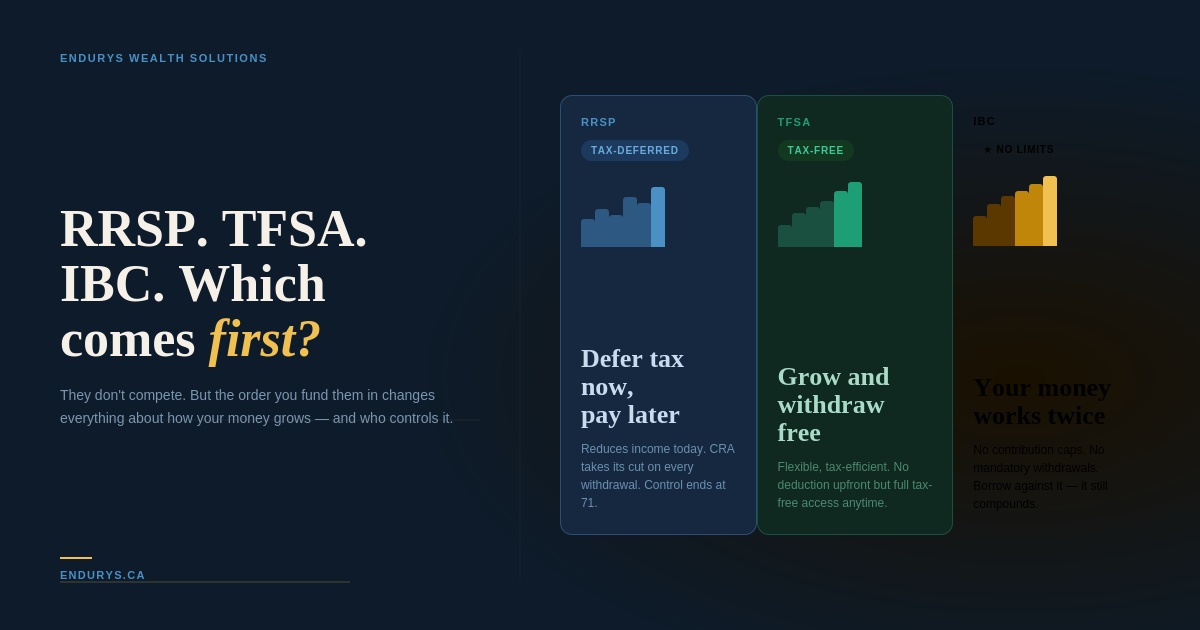
IBC vs. RRSP vs. TFSA: Which Comes First for Canadians?
You know you should be saving. You have heard you should max your TFSA first, then your RRSP — or was it the other way around depending on your income? Then someone tells you about Infinite Banking and suddenly you do not even know where to start.
This is one of the most common questions I get. The short answer is that IBC does not replace your RRSP or TFSA. But understanding the real difference between all three changes everything about how you think about your money.
A Quick Breakdown of Each Account
RRSP — Registered Retirement Savings Plan
You put money in before tax. That reduces your taxable income for the year, which means a refund at tax time if your employer withheld too much. The money grows inside the account without being taxed every year. But when you take it out — in retirement or anytime — you pay income tax on every dollar you withdraw. This vehicle works best for people in a high tax bracket now who expect to be in a lower one when they retire. RRSPs must be converted into a Registered Retirement Income Fund (RRIF) no later than the end of your 71st year of age. You are trading a tax break now, for less control in the future. The CRA will have their cut.
TFSA — Tax-Free Savings Account
You put money in after you have already paid tax on it. There is no upfront deduction, but the money grows completely tax free, and you pay zero tax when you take it out. You can withdraw any time for any reason. The contribution room comes back the following calendar year. It is flexible, tax efficient, and often misunderstood as just a savings account but it can hold investments too. Excellent investment vehicle.
IBC — Infinite Banking Concept
IBC is not a government registered account. It has no contribution limits set by Ottawa. It is a strategy built around a specially designed participating whole life insurance policy.
Here is how it works:
The cash value inside the policy must equal the death benefit at the life insured's age of 100. This forces the cash value to grow every single day through guaranteed daily compounding, it has no choice but to grow in order to reach the death benefit by that age.
As the policy owner, you have the right to borrow up to 90% of the available cash value at any time. That loan uses the death benefit as collateral. Because the death benefit is guaranteed to pay out, the loan is completely unstructured. That means no fixed payments, no mandatory repayment schedule. It will not appear on any credit report. It will not impact your ability to borrow from a conventional bank.
Here is the part most people cannot believe: while your loan is outstanding, your full cash value keeps growing as if you never borrowed against it. The insurance company is lending you their money, secured by your death benefit. Your equity keeps compounding the entire time.
Why IBC Is a Different Category Entirely
Your RRSP and TFSA are savings containers. They have contribution limits, government rules, and withdrawal conditions. They are excellent tools but they are fundamentally buckets. You put money in. It grows. You take it out when the rules allow.
IBC is a financing system. The goal is not just to grow wealth inside the policy. The goal is to use the policy as your own private bank replacing the role that chartered banks play in your financial life. The result is that instead of paying interest and having obligations to a bank for the things you are financing, you finance from your own system which means you profit from the interest and you are in complete control.
Your RRSP and TFSA are designed to grow wealth in a tax-advantaged environment. IBC is a process centered around how you finance the things you need, that happens to come with tax-advantaged growth.
The fundamental difference is in the problems they solve. RRSPs and TFSAs solve the need for tax-efficient growth of your money over time so you have more later in life. The goal is the highest rate of return you can get.
IBC solves the problem of a significant portion of your money going towards paying interest. The goal is to recapture all of your financed items both now and in the future so the interest drag gets turned into a cash generating asset. Your RRSPs, TFSA and IBC system work in tandem. They don’t compete against each other.
There are only two ways of earning an income: people at work, and money at work. Your RRSP and TFSA put your money to work inside government controlled containers. IBC puts your money to work inside a system you control; one where your capital keeps compounding even while you are using it. You send one dollar to work in two places at once.
The Order That Makes Sense for Most Canadians
The best place to start is with education. You need to understand your situation, your goals, and the purpose each vehicle serves. This is not a one-size answer, but here is a framework that works well for most situations:
IBC first – A better storage container for an emergency fund. The biggest threat to Canadian’s wealth is debt. The average household debt to income ratio in Canada is 175%. It doesn’t matter if you get 10% annual returns on your investments if 35% of your after-tax income goes to interest. Solve this first by being strategic with where you store your savings. Leverage your savings to tackle your debt.
TFSA next — for your excess income. Once you have a foundation built in a policy to attack your interest leaking debts, start to build for the future. TFSAs give you the most control outside of a policy.
RRSP if you have an employer match. An employer matching your contributions is a guaranteed return before any market growth happens. Take the free money, but be aware that you are giving up control of this money in the future. Use this strategically.
Long term — IBC becomes the foundation. Unlike registered accounts, there is no annual contribution limit on a life insurance policy. It grows outside the registered system. It compounds guaranteed. And it gives you something your RRSP and TFSA never will: access to capital on your own terms, without going to a bank.
What IBC Can Do That RRSP and TFSA Cannot
Borrow against your savings without triggering a taxable event or losing contribution room
Use capital to fund a real estate purchase, pay down a mortgage, or cover a business expense — and repay it on your schedule
Leave a guaranteed death benefit to your family that passes outside of your estate
Access capital with no credit check, no income verification, and no impact on conventional borrowing
Build a system with no government imposed withdrawal age or mandatory minimum drawdown
Ready to See Where IBC Fits in Your Situation?
Everyone's starting point is different. The best way to figure out how IBC works alongside your existing RRSP, TFSA, and everything else is a real conversation about your actual numbers.
Book a free call with me at Endurys Wealth Solutions. I will show you exactly how these pieces work together and what a system built around your cash flow actually looks like.
[Book Your Free Call → endurys.ca/book]
Sources
Canada Revenue Agency — Tax-Free Savings Account — Official CRA rules on TFSA contribution limits, eligible investments, and withdrawals
Canada Revenue Agency — Registered Retirement Savings Plans — Official CRA guidance on RRSP eligibility, limits, and tax treatment
Infinite Banking Concept — Official IBC Institute — Founded by Nelson Nash, the originator of the Infinite Banking Concept; foundational explanation of IBC mechanics

