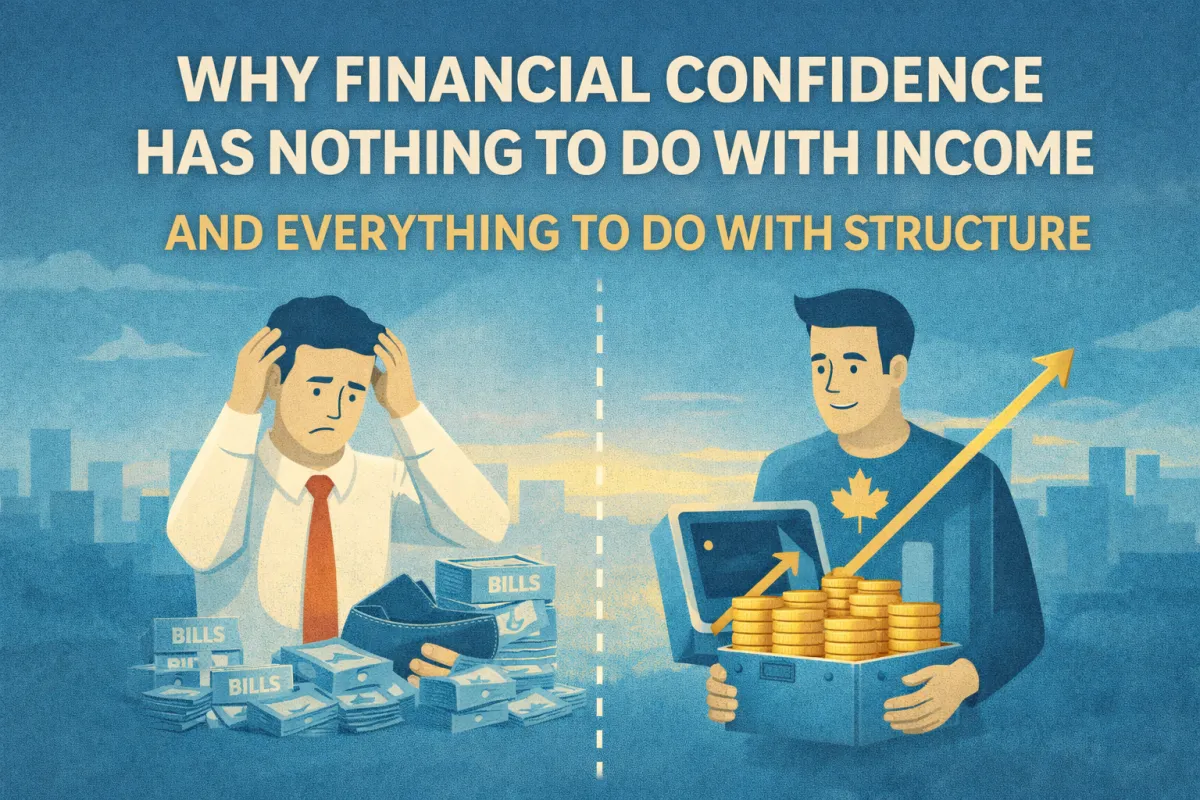
Why Financial Confidence Has Nothing to Do With Income, and Everything to Do With Structure
The saying “money can’t buy happiness” is completely false. Of course it can, but that is a double-edged sword. Money can just as easily buy despair, regret, and anxiety if used incorrectly.
There are many high-income earners who live paycheque to paycheque, and there are many modest earners who have full cash confidence.
It isn’t just about how much money you make, it’s more about what you do with it. More specifically, it’s more about the system you have in place to manage your money.
Here is an uncomfortable truth. Most people don’t make money; they just handle it. Let me explain. Let’s use a simple example and say your monthly after tax income is $1000. $500 goes towards housing, $200 goes towards transportation, $200 goes towards food, and $100 goes towards savings. Out of that $1000, how much did you retain in our example? You only retained control of $100, or 10% of your after-tax income.
The remainder of that money you only handled. What I mean by that is, that money has left your control forever, and you can no longer use or profit from that money. Conversely, the $100 you retained, you still have complete control over that and can do with that as you wish.
It is the money you retain that leads to cash confidence. It’s the amount of money that you have control over that leads to building wealth over time.
How you keep more of your money is by building a system to retain it, rather than just handle it. Without a system, you are exposed to Parkinson’s Law: expenses will rise to match income. This is exactly how high-income earners end up living paycheque to paycheque.
Because they see a large dollar amount entering their accounts each month, they figure they can afford whatever it is they want, and the volume of income will pay for it all. They don’t account for interest; they don’t account for long term financial planning. There is no system.
A budget is a type of system, but it acts more of a diagnostic tool than a true way to create wealth. A budget will breakdown exactly how much money you retain versus how much money you handle, but it doesn’t solve the problem.
Budgeting can also help you live below your means and free up additional cash flow each month to be used for investing and building wealth, which is excellent, but it still doesn’t solve the problem of handling money.
The goal of any financial strategy is to live below your means, and maximize the amount of retained money to invest in your future. It comes with scrutiny and tough choices now so you can maximize your lifestyle later.
I don’t want to do that. I prefer to eliminate the amount of money that is handled, and make my entire income work for me versus only a portion of it.
To do this, we need to understand banking. We do a deep dive into banking in another blog so I’ll keep this short.
Banking works by an institution accepting deposits of money for storage. With the knowledge that not every depositor will need access to their money at the same time, the institution then lends out those depositor’s money to borrowers, charging interest for the privilege of accessing that money, in order to make a profit. The depositors earn a small amount of interest on their money as an incentive to keep that money in the account so the bank can keep lending it out.
The depositors are none the wiser that this is occurring because what they see is a number on a screen representing a balance in their account. There is no actual money sitting in a vault at the bank, that money stays in motion so the bank can profit.
If we can mimic this function, we can eliminate all handled money from our budget, and instead retain all of it.
What we need is a place where we can deposit our money and not have to withdraw it in order to access more money. What we want to do is instead leverage an asset that we are building. This is not uncommon in society, its actually very, very common with the ultra wealthy because loans aren’t taxable.
What they do is buy assets that are going to be stable and appreciate in value. Then they go to a lending institution and take a loan with the asset as collateral. They get access to money in the short term, and the bank knows it will get its money, plus interest, once the loan is due. If the loan isn’t paid back, they get the asset.
How can we mimic this if we don’t have billions of dollars in assets? We use a Participating Whole Life Insurance Policy. These policies have financing properties that work extremely well at mimicking a banking system.
When you pay your premium, a portion of that premium is available to you in the form of cash value. We can take a loan against the cash value to access real dollars. The loan is from the life carrier, and the policy owner has a contractual guarantee to access that money. The loan comes with simple interest, but no structure in terms of repayment. The lean is against the death benefit of the policy, which is guaranteed to pay out.
The cash value grows because the cash value must equal the death benefit at the life insured’s age of 100. However, if we design this policy to be maximally efficient, we want a way to continually increase the death benefit. We can do this. Then, a portion of our premium payment goes towards paying the base premium, or the amount of current coverage, and a portion goes towards buying additional coverage, or death benefit. When we do this, the contract hasn’t changed. The cash value must still equal the death benefit at the life insured’s age of 100. What this equates to is guaranteed daily growth of cash value.
Back to our banking system. Now we have a place where we can deposit money, have contractual authority to take a loan based off the value of our deposits, while our deposits continue to compound and grow uninterrupted in the background.
In the loan provision, there will never be stipulations on repaying the loan since the life carrier knows the death benefit will pay out eventually.
Better yet, with a participating policy, you actually become a co-owner of the life carrier. As a part owner, you get to share in the divisible surplus that is generated from the participating accounts. This means even though you are paying interest on the loan, you are in fact getting that money back in the form of a dividend.
Now the amount of the dividend isn’t tied to the amount of interest you pay. Its actually tied to the amount of premium you have paid. This means, over time, the amount of your dividends is going to increase.
Back again to our system of retaining our money rather than handling it. If we put our earned income into our personal banking system, we retain control over that money. When we need to spend money, we are using the life carrier’s money to do so through the use of policy loans. While we use the life carrier’s money, our money continues to compound and grow in the background. When we repay our loans, we not only refill the pool of money we can borrow against, the interest we pay is directly feeding the profits of the life carrier, which we get to share in through dividends.
Now we have a fully enclosed system designed to maximize the wealth potential of our earnings rather than allow us to be taken advantage of.

